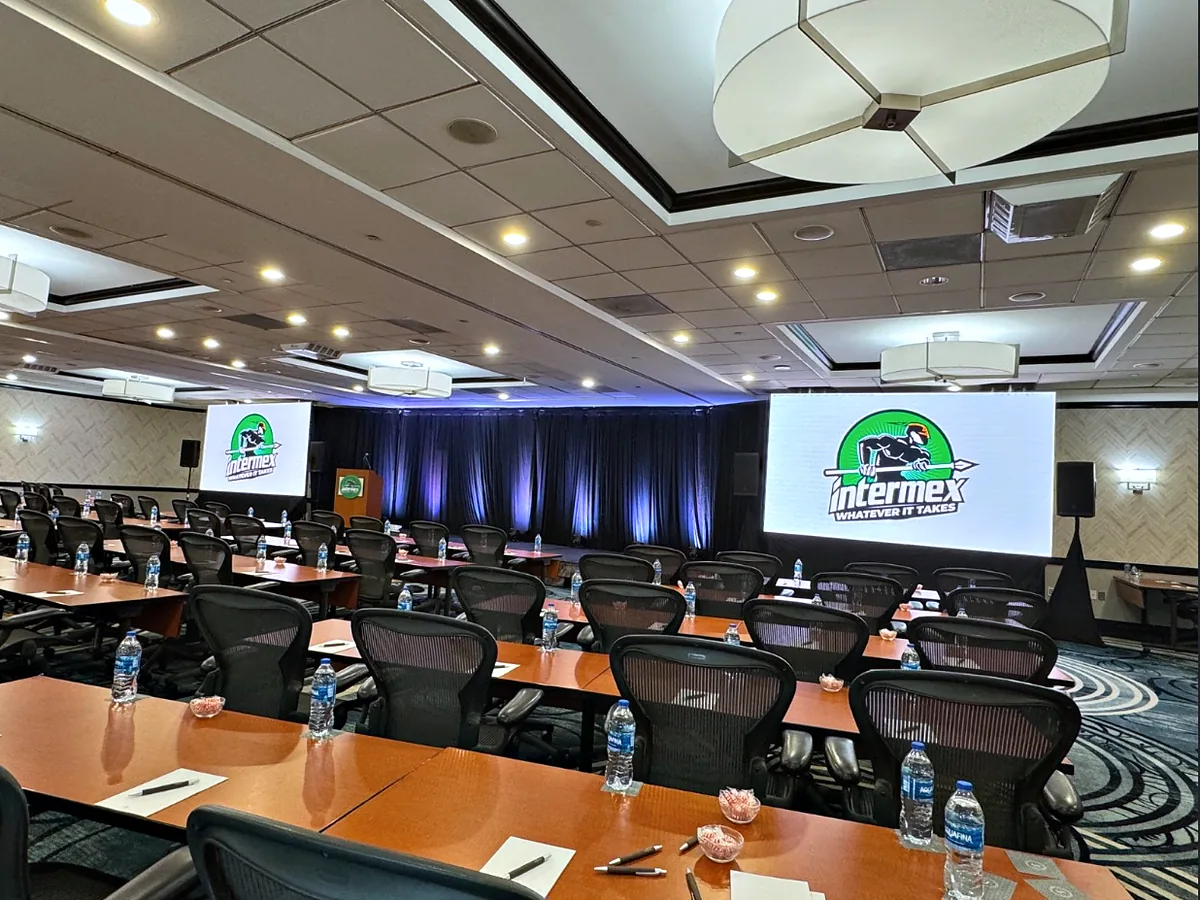
A center stage, and one graphic across both walls.
What is there, and the one choice in it that looks like an omission and is not.
A stage in the middle of the room with a video wall either side of it, both carrying the same graphic. Behind, pipe and base lit from the back. Loudspeakers on stands, and the room set with tables.
The decision worth pointing at is the mirroring. Two surfaces make it possible to show two things — slides on one and a camera on the other, or a split that gives each half of the room its own content — and the moment you do, half the room is looking at the wrong one and knows it. Putting the same graphic on both makes every seat the same seat. That is the right instinct for a meeting whose entire purpose is that everybody present gets the same information at the same time, and it is the sort of choice that costs nothing and is noticed only when it has not been made.
A center stage has more than one front.
Putting the stage in the middle buys sightlines and costs you everything that assumed the audience was in one place. The second wall is the first thing that falls out of it.
Nobody is far, nobody is square on
An end stage puts the whole room in front of it and the back row a long way off. A stage in the middle halves the deepest sightline — the same seats wrap around instead of stacking up — and in exchange no seat is square to it the way an end-stage front row is. Depth is traded for angle, and every other decision on the job is a consequence of that trade.
One surface cannot serve both halves
A single wall beside a center stage faces one part of the room and turns its back on the rest. An LED surface loses brightness and shifts color off axis long before it stops being legible, so a wall read at a steep angle is not the same picture as the one read square. Two surfaces, set to face the seats they are actually serving, is the version where everybody gets the same picture.
Trim, twice over
Height is usually what caps a wall in a ballroom, not width. Splitting the surface lets each half sit under the clear height available at its own position — and that is not always the same figure across a room, because a soffit at the perimeter, a chandelier grid down the centerline and a service run over the back of house are all real.
What it costs you
Two surfaces are two pixel maps, two paths through the processor and two sets of content decisions. They also have to match each other — same panels, same calibration, same brightness — because two walls in one eyeline get compared constantly in a way one wall never is. A difference in color between them is visible from the back of the room, and it is not fixable from the console once the show is up.
Pipe and drape is masking. Lit from behind, it is a set.
Accent lighting was part of this build and the backlit drape is most of it — the cheapest scenic element in this business, and the one that most often gets hung and then left dark.
- What it is, and what it is normally for
Uprights in weighted bases, a crossbar between them, fabric hung off the bar. It is the standard way to make a temporary wall, and its usual job is masking — hiding the back of house behind the stage, which on a meeting like this is cases, cable, a crew position and whatever the room’s own back wall happens to look like.
- What backlighting changes
Light on the face of a drape flattens it. Light behind it turns the fabric into a lit surface with depth in it, gives the two walls an edge to sit against instead of a black void, and puts a color in the room that the client chooses. It also lifts the whole upstage picture off black, which is what keeps a lit speaker from reading as a silhouette to a camera.
- It needs depth, and the depth is real floor
Fixtures behind a drape need distance to cover it evenly. Close in, they scallop, and every fixture shows through the fabric as a hot spot. That gap is floor you do not seat, and it is the thing most often discovered at load-in rather than on the plan. The fabric matters as much as the fixture: a tight weave reads as a lit surface, an open one as a glow, and a heavy dark fabric absorbs most of whatever you put behind it.
- One color is a decision, not a default
A backlit drape is the easiest thing in the room to change between segments, and therefore the easiest to overuse. On a meeting that runs to a script and a clock, a single held color that belongs to the brand does more work than a sequence does: the walls carry the information and the drape carries the room.
- The rest of the accent layer is what the camera sees
Beyond the drape, accent light is what stops a room reading as a lit stage in a dark box: color on the perimeter, enough light on the tables for people to read and take notes, and front light at the speaking position that a lens can work with. On a meeting being streamed, that layer is most of what a wide shot is made of — a room lit only where the speaker is looks empty on camera whether or not it is.
Somebody owns every deck in the room.
Presentation management was part of this build, and it is a real discipline that almost nobody writes down: one machine, one library, one person, and a version of every deck that is known to be the current one.
- One machine, not six laptops
Every deck runs off a managed playback machine rather than off whatever each presenter brought. That removes the whole category of failure a room sees most: a laptop that will not talk to the switcher, a resolution nobody expected, a sleep setting, a notification across a slide, a dongle that is somewhere in a bag. The presenter gets a confidence monitor and a clicker. The machine gets the deck.
- Version control is the actual job
Decks arrive late, get revised after they arrive, and get revised again in the room. The discipline is knowing which file is current, who approved it and what changed — a naming convention, a cut-off for changes, one person who accepts them, and a preserved copy of what was running when the session started. Where the wording on screen is the wording being minuted, that is not administration. It is the show.
- Decks break in predictable ways
Fonts that are not on the playback machine. Linked video that is not in the folder. Animation built in one application and opened in another. Slides authored at a different aspect ratio from the surface they are going on. Every one of those is found by opening the file on the machine it will run on, in the room it will run in, before the day — which is the only test that means anything.
- Cueing a presenter who has never done this
Most people speaking at a meeting like this are not performers, and a confidence monitor, a clicker and a countdown are unfamiliar objects. The work is a walk-through: where the slides appear, which way the clicker goes, where to look when there is a camera, and what to do when a slide does not advance — which is nothing, because the next sentence buys the operator the two seconds it takes. Ten minutes each removes most of the visible failures in a session.
- The holding state is content too
Between segments, and before the doors open, something is on both walls — and it is chosen rather than left over. An agenda, a title, a brand field. On a wall it is also a power decision, which is the next section; on a stream it is the first thing a late arrival sees.
The content is held, not cut.
A governance meeting is a different show from a conference, in ways that all land on the technical plan rather than on the agenda.
- A slide sits still for a long time
A meeting like this holds a slide — a resolution, a table of figures, an agenda item — while it is spoken to and minuted. That is the case the full-white maximum exists for: a bright near-white field held for minutes is what the circuits, the breakers and the cable are sized against, even though the wall’s draw across the day averages about a third of it. On the published panel series we work the numbers from, the average is 33 to 34 percent of the maximum on every pitch in the range.
- Intelligibility is the whole job
What is said in the room is the record. The sound has to be even across a room that wraps around a stage and clean enough to record from, which means covering outward from more than one position and aiming away from the open microphones in the middle of it. Two loudspeaker positions rather than one is the same geometry argument the two walls are.
- The speaker has a back, and it faces somebody
Whichever way a presenter turns on a center stage, part of the room is behind them. That is the second thing the second surface is for: the half of the room that cannot see a face can still see the content, and a camera at one side puts the presenter on the walls as well. Where somebody has to be able to work without turning round, the confidence feed is duplicated for the same reason the walls are.
- The nearest faces are close
Tables put the front row nearer the surface than theater rows do. On the pitch ladder, 2.9mm is comfortable from about ten feet and 1.9mm from about six; where the first table sits inside that, or where a camera holds a tight shot with a wall behind it, the finer pitch is the specification rather than the upgrade.
The people not in the room are still in the meeting.
Live streaming was part of this build. Someone attending a meeting like this remotely is not an audience watching a recording — they are present, and what they can hear is what decides whether that is true.
The stream takes the same graphics the walls take and its audio off the console rather than off a microphone in the room, so somebody watching hears the speaking position and not the ballroom. What gets said is the substance of the meeting, which makes intelligibility on the feed the whole of what the remote half of the room has.
A center stage makes the camera plan harder and the content plan easier. Harder, because no single position sees a speaker from the front all of the time and the room is in every wide shot from somewhere. Easier, because both walls are already carrying the same graphic, so the source feeding them is the source the stream cuts to — a remote viewer gets the deck full frame rather than a photograph of a wall with a room around it.
And the stream keeps its own clock. An encoded picture is not the same moment as the room: the gap gets measured rather than assumed, and anything in the room showing the stream back to itself is accounted for before doors. A recording of the same program output runs alongside it, because a stream that drops leaves no copy and a meeting like this is not one you can run again.
Send the room, not the equipment list.
Whether the stage goes in the middle or at the end decides the surfaces, the loudspeaker positions and the camera plan — in that order.
No client name and no venue goes on this, and there is no date and no headcount. What was built does, in the words it was described to us in.
Send the room dimensions, where you want the stage, what is already standing that cannot move, and the clear height where the surfaces would go — and the answer comes back as a drawing rather than as a quantity of panel.
Call (561) 750-4070 or email contact@southfloridacorporateevents.com. If you would rather see how the number is arrived at first, how we scope a project sets out the nine drivers in the order they move an estimate.