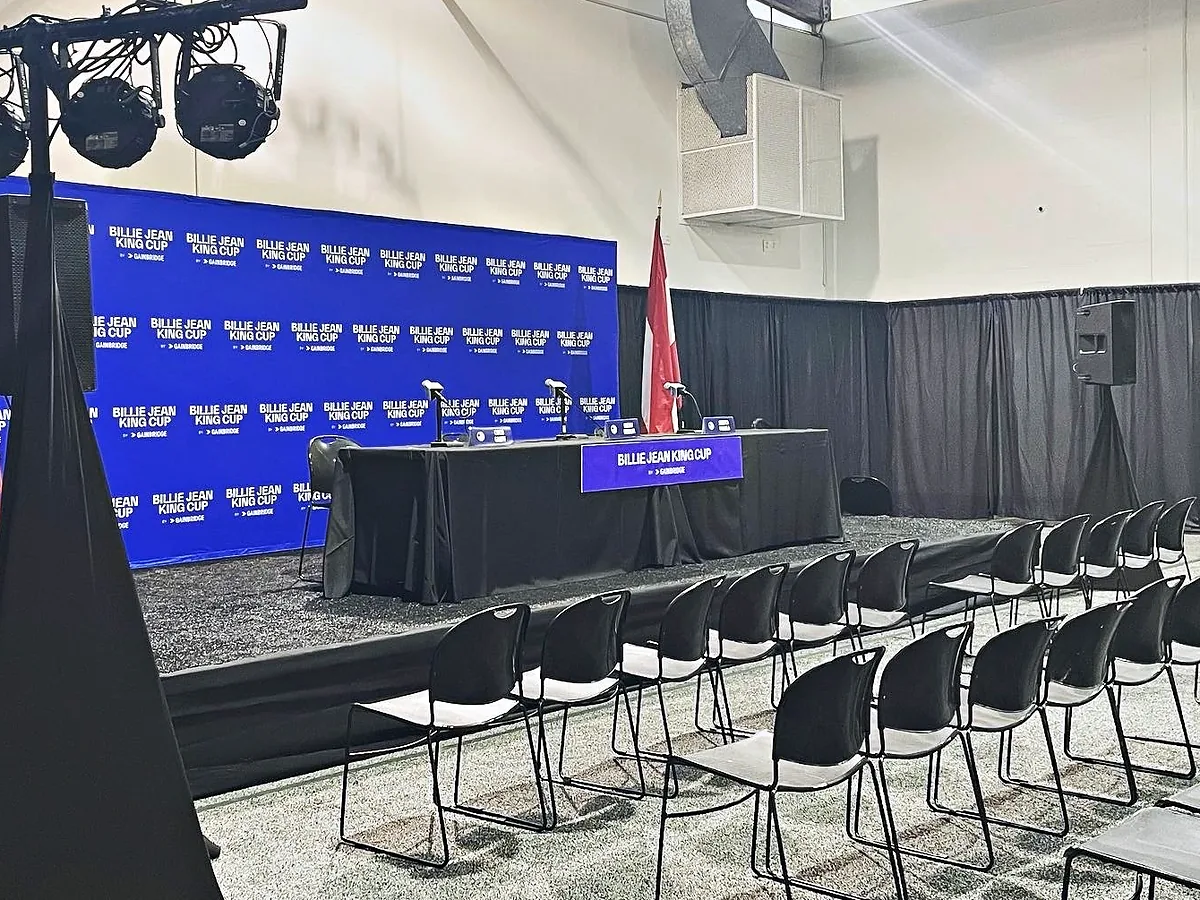
Four productions at once, and only one of them indoors.
Court audio, a press conference room, feeds leaving the site to television stations, and video on the sponsor walls. They share a site, a schedule and a crew, and almost nothing else.
The courts are outdoor rooms with no ceiling and no back wall, running to a clock nobody controls — a match ends when it ends. The press conference room is indoors, small, and full of cameras. The sponsor walls are unattended surfaces in direct sun. The feeds to the television stations are the only part of the job that leaves the property, and the only part where a fault is somebody else’s picture rather than ours.
What ties them together is one thing: the site is large and signal has to cross it. Every one of those four lines is a distribution problem before it is a production one — where the sources are, where the destinations are, what carries the signal between them, and what each destination falls back to when a run is cut. A ballroom has a cable run measured in feet across a floor. A site has runs measured in hundreds of feet between structures, outdoors, in weather.
So the order of work inverts. Infrastructure first — the paths, the power and the positions — and then the things that plug into them. Nothing about the press room’s set matters if the line out of the building has not been proved, and nothing about the sponsor content matters if every wall cannot be reached from one playback position.
A stage for the conference, a riser for the cameras.
Two structures facing each other, and the height of each one is set against the other. That is the whole geometry of a press room, and it is settled before anybody lights it.
- The stage puts the faces above the pool
A speaking position at floor level, in a room of seated and standing press, produces a picture of the back of somebody’s head. One deck height is usually enough to lift the people talking above the heads in front of them, and that is the difference between a shot an outlet runs and a shot it does not.
- A press riser is a structure, not a courtesy
A camera riser at the back carries tripods, operators and their cases, and it has to be stiff as well as strong — a deck that moves when somebody walks across it moves every long lens standing on it. It goes square to the stage on the center line, because that is the only position that gets faces rather than profiles, and it goes in before the chairs rather than around them.
- The two heights are one decision
Too low, and a camera looks up at a speaker and puts the top edge of the backdrop in frame. Too high, and it looks down at a seated table and loses whatever is behind it. Stage height and riser height are set against each other, and both are settled before anybody starts lighting, because moving either one afterwards moves the light.
- The backdrop is the half the client sees afterwards
A step-and-repeat behind a speaker is framed by every camera in the room, so the spacing of the marks on it has to survive the tightest shot anyone will take: if the repeat is wider than a head-and-shoulders frame, some of the pictures that run carry no mark at all. That is a measurement taken in pre-production against the shots outlets actually use, not a thing discovered at load-in.
One set of microphones, a host of television stations.
Press box audio connections feeding live audio out to a host of different television stations is the part of this job nobody sees, and it is the part where one wiring decision reaches everybody taking it.
- A mult is one source and many outputs
A press mult is a distribution box that feeds line-level outputs to every outlet taking the audio, off the same microphones. Without one, a table grows a forest of handheld recorders and shotgun mics: it sounds worse for everybody, it looks worse in every frame that runs, and each one is a separate thing to fix when it fails. With one, there is a single gain structure to set and a single set of microphones to check.
- Isolated is the whole point of the box
The outputs are isolated from the source and from each other — transformer or active, but isolated. Broadcasters arrive with their own equipment, their own grounding and their own idea of what line level means, and plug into a panel they share with everyone else. Isolation is what stops one bad connection putting hum, or silence, on every other feed on that panel.
- Label the panel, then stay with it
A shared panel gets used by people who did not build it, under time pressure, often in low light. Every output is labeled at the panel with what is on it, levels are set against a known reference rather than against whoever happens to be talking, and somebody stays with it while it is live. A feed nobody is watching is a feed that fails quietly.
- The room mix and the feed mix are different jobs
What the loudspeakers do for people in chairs and what goes down the line are not the same mix. The room needs enough level to be intelligible at the back without lighting up the open microphones at the front; a feed needs close, even, consistent level with as little room in it as possible. Two mixes off the same inputs, and somebody watching both meters rather than one.
- Record what you send
A local recording of the same program audio costs nothing and is the only copy that exists if a path drops in the middle of an answer. It is also what a transcript gets made from, and a transcript is usually wanted faster than anybody planned for.
Across a site, distance is measured in milliseconds.
Full tournament audio across all the courts is a distributed system, not a large one. What makes it hard is not level. It is that sound is slow, the rooms have no walls, and every court is audible from the next.
- Sound covers about a foot every millisecond
Sound travels about 1,125 feet per second in air at 70 °F — 1.125 feet per millisecond, near enough to a foot. So a loudspeaker a hundred feet further from a listener than another one arrives about 89 milliseconds later, and two arrivals that far apart are not one sound any more. They are an echo of it. Covering a long seating bank from one position is a level problem; covering it from several is a timing problem, and the delays get calculated from the distances rather than dialled in by ear.
- An outdoor room returns nothing
Indoors, a room puts energy back into the mix and a rough loudspeaker position survives it. Outdoors there is no room: what the boxes do not put on a seat, nothing else will. Coverage comes entirely from the cabinets and the angles, level falls away with distance faster than anyone expects, and the far end of a bank is only ever as loud as it was aimed to be.
- Every court hears every other court
Zones on a site are not acoustically separate. What is loud enough on one court is audible on the next, and an announcement or a music bed on one is a distraction during a point somewhere else. Zoning, aiming and level limits are one design decided together, and being able to address a single zone is what makes a system usable rather than loud.
- Speech is the job, and none of it is rehearsed
Calls, announcements and presentations are the content, and none of it arrives as a cue anybody has run before. Intelligibility at the back of a bank, in wind, over crowd noise, is what the system is specified for — and that sets the box, the aim and the delay long before anybody asks how big it is.
- Weather is part of the specification
Loudspeaker positions, cable runs and power on a site are exposed for the length of the event. Temperature moves the speed of sound, wind moves where the sound ends up, and rain stops the tennis before it stops the audio. Protection, rigging and the ability to reach something in the middle of all that are designed in, because the one thing a live site never offers is a quiet hour to work in.
Where the figure above comes from
- The speed of sound in air at 70 °F — 1,125 ft/s, the standard figure every delay calculation on a site starts from
- 100 ft ÷ 1.125 ft per millisecond = 88.9 ms, worked on the page rather than asserted
Video around a site: in the sun, and unattended.
Video for the sponsor video walls around the courts is a different discipline from a wall behind a stage. Nobody is watching them for you, the sky is behind them, and they have to read at a glance from across a court.
- Pitch comes off the nearest seat that matters
On the industry’s working rule of roughly one meter of comfortable viewing distance per millimeter of pitch, a 4.8mm outdoor panel is comfortable from about sixteen feet and coarse closer in. That is right for a surface read from across a court and wrong for one somebody sits under. Pitch is chosen from the closest seat that has to read it, never from the furthest.
- Brightness is the outdoor specification
An indoor wall is competing with a lit ballroom. An outdoor wall is competing with the sky. On the published panel series we work our figures from, the outdoor lines are rated 4,500 nit against the 1,000 published for the indoor 1.9mm line — four and a half times the output, for the same reason a phone screen disappears at the beach. Content follows the same logic: high contrast, few words, no thin type, nothing that turns on a subtle color.
- The power is not big, it is spread out
On the published figures for those outdoor lines — 600 to 800 watts per square meter at maximum, 200 to 267 on average — every ten square meters of sponsor wall is about 2 to 2.7 kW through normal content and up to 8 kW on a full-white frame. Spread that across several surfaces in several places and the question stops being how many kilowatts and becomes where they come from: a distro at each position, a run to it, and a generator wherever there is no building to tie into. Generators from 6 to 80 kW, and distribution in all sizes and types with soco, are what that gets answered from.
- One playback position, several destinations
Surfaces scattered around a site are still one show. They run from a playback position to a schedule, and the questions are ordinary distribution ones: what carries the signal that far, whether every wall shows the same thing or its own, and what each one falls back to when a source drops. An unattended wall showing an error message is the most public failure available on a site.
Send the site, not the room.
A tournament, a festival or anything else with more than one thing happening at once is scoped from distances and destinations before it is scoped from equipment.
We do not publish client names, and there is no venue, no date and no headcount on this. What is above is what we supplied and the craft it takes.
Send the plan of the site, where the press room sits in the building, who is taking the audio and where the sponsor surfaces go, and the answer comes back as a distribution drawing with the runs and the power already on it.
Call (561) 750-4070 or email contact@southfloridacorporateevents.com. If you would rather see how the number is arrived at first, how we scope a project sets out the nine drivers in the order they move an estimate.