Equipping the room and running the show are not the same order.
Both end in a general session that works, and plenty of inquiries name the first when they mean the second. The difference is what the estimate is actually buying, and it is worth settling in the first conversation.
AV rental
Answers a question about the space: how wide the screen has to be for the back row, whether the ceiling will fly a wall or the floor has to hold it up, how coverage is aimed in a room that shape, how the wireless behaves in a building running three other groups the same morning. The rig arrives, it is installed and calibrated, it is operated, it is struck. The room physics, the rigging and the RF behind all of that are set out on our Miami AV rental page.
- AnswersHow the room gets equipped
- DeliverableA rig that is right for the space
- Decided byThe building and the seating plan
Event production
Answers a question about the program: what happens, in what order, on whose cue, and who decides when it stops going to plan. Here the rig is an input. The output is ninety minutes that start on time, hit the video on the right frame, get the chief executive on and off, and hand the room to the next thing without a gap nobody planned for.
- AnswersWho runs the room and the clock
- DeliverableA running order that survives the day
- Decided byThe program and the people in it
An agenda is a plan. A run of show is an instruction set.
It is the deliverable most often underestimated. An agenda tells a room what is happening; a run of show tells eight people what to do about it, to the cue.
What is actually in it
Every segment in order with a duration, and against each one: the source on screen, the audio state, the lighting look, which microphones are live, when the video rolls, and who is standing where before the light changes. It gets written in pre-production, argued over once, and then it is the only version — because the moment two versions exist, the desk and the deck are working from different documents.
Where the time really goes
Agendas get built out of content, and the joins go missing. Walk-ups and walk-offs, a panel re-set with four chairs and four microphones, an award handed over, a laptop swap at the lectern: every one of those is real time and none of them is on a slide. We time the joins at the same resolution as the content, which is why a program that looked like ninety minutes stops turning into ninety-seven on show day.
Decisions made before the day
The running order also records the decisions nobody wants to make live: what gets cut if the morning runs long, who is allowed to cut it, where the buffer sits, whether the break can absorb ten minutes, and which segment is protected no matter what. Settling those in pre-production takes twenty minutes. Settling them at the back of a full ballroom takes longer than the time you are trying to recover.
On show day, somebody owns the room.
Four functions, and you should know which chair each one sits in before load-in. The common failure at a corporate general session is not a missing skill — it is a room where three people can each half-make a decision.
The producer
Carries the show from the first site survey through load-out: the running order, the content, the rehearsal schedule, your priorities, and what happens to the rest of the day when one of them moves. This is the person you call, and the person who has already had the awkward conversation with the venue. It is the same person in pre-production and on site — a handover between those two is where detail goes to die.
The show caller
Sits at the desk with the running order and calls the show as it happens: standby and go on every cue, to the audio, video and lighting positions and to whoever is standing with the presenters. One voice on comms, one document, every operator working to the same count. This is the role that is never in a package built as a gear list, and it is the role that makes a multi-segment program look inevitable rather than lucky.
The stage manager
Speakers found, microphoned, briefed and standing where they need to be before the light changes — which is a wing in a ballroom, the top of a runway at a fashion show, and a line of people holding scissors at a ribbon cutting. Clickers handed over and taken back, panel re-sets rehearsed, and a quiet channel to the desk when somebody is not where the running order says they are. Most overruns are recovered here, next to the people, before they ever reach the desk.
The desks
A1 and A2 on audio, the video operator on the switcher and playback, the lighting operator on the console — our own staff on our own inventory, working from the same running order. The crew that rigs the room is the crew that runs it, which is why a standby called in rehearsal is answered the same way at nine the next morning.
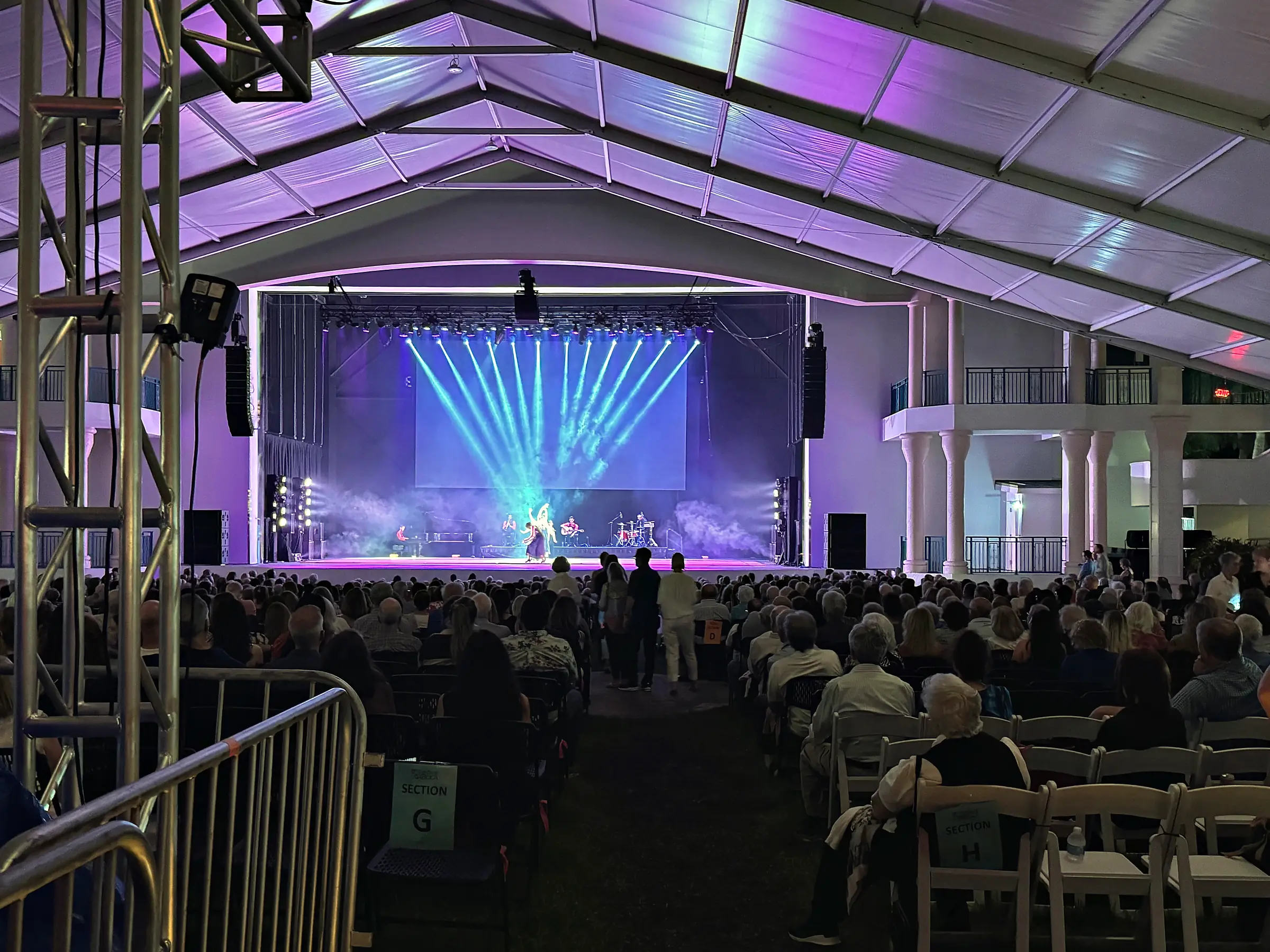
Rehearsal is scope, not slack.
Four hours minimum for a multi-segment general session, and those hours do four separate jobs. Compress them and one of the four does not happen — in practice, the last one.
Dry tech
Focus, levels, looks, and every source proved through the whole chain onto the wall in its final version rather than as a placeholder. No speakers in the room. This is where a file that plays on a laptop but not through the switcher gets found, and that is a fifteen-minute problem at eight in the evening and a show-stopping one at nine the next morning.
Cue to cue
The show run in order, but only the transitions: the last line of a segment, the cue, the first frame of the next. Content is skipped, joins are not, because the joins are where a show breaks. It is the fastest way to prove a running order, and it is the difference between a show caller reading a document and a show caller who knows what is coming.
Speaker walk-through
Each presenter walks their own segment: where they come on, where they stand, where the confidence monitor is, how the clicker behaves, what the light does when they start. Ten minutes each removes most of the visible failures at a general session — a keynote hunting for their slides, a panel arriving at chairs with no microphones on them, an executive walking into the wrong light.
The failover and the reset
The backup path gets switched to under rehearsal conditions, because a redundant playback machine nobody has cut to is a theory. Then the room resets to top-of-show state and stays there — holding slide up, microphones off, lights in preset — so the first person through the door in the morning sees the show and not the rehearsal.
Every show leaves the running order. That is what it is for.
Three of these happen at most general sessions. None is a crisis where the decision has already been made and the room knows who makes it.
A speaker overruns
Somebody eleven minutes into a six-minute slot is the most common event in corporate production, and the response is a decision rather than a reflex. The producer and the show caller work the plan agreed weeks earlier: the stage manager signals from the side, the next segment is trimmed or the buffer is spent, the break absorbs what is left, and if the overrun is structural then the protected segment is defended and something else goes. What nobody does is invent the answer at the desk while it is happening — and nobody throws a lighting cue at a speaker mid-sentence unless you have told us to.
The deck changes at 8:40
It will. A new version arrives with the room already seated, and the only safe answer is a process: one person takes the file, it is named and versioned, it goes through the same chain it will play through, and the show caller is told what changed before the segment rather than during it. Late content is survivable. Late content dropped straight onto the switcher untested is how a general session opens with somebody’s notes view on a sixteen-foot wall.
Something fails mid-keynote
Answered long before show day, by deciding which segments cannot be re-run and what protects them: a second playback path, a redundant feed through the processing, a spare handheld already keyed, a look the lighting operator can reach on one word. Owning the inventory and employing the crew makes that straightforward to plan and fast to execute. The test is never whether the room has a spare — it is whether anyone has cut to it in rehearsal.
In Miami, the building sets the clock.
The producing job changes more between these four than the gear list does. What changes is when you get the room, who else is in the building, and how much of the day is actually yours.
Convention center halls and ballrooms
Miami Beach Convention Center · Brickell City Centre
A campus publishing 491,654 square feet of exhibition halls, a Grand Ballroom of 60,979 square feet and up to 84 meeting rooms is running several shows at once. Your general session shares an air wall, a dock and a freight route with somebody else’s, and rehearsal happens in the window the building gives you rather than the one your program wants. Producing here is mostly schedule: the rehearsal hours get booked and defended in pre-production, and the running order is built around the time you genuinely have rather than the time you hoped for.
Hotel ballrooms with a group in before you
Fontainebleau Miami Beach · JW Marriott Marquis Miami · InterContinental Miami · Four Seasons Hotel Miami · The Ritz-Carlton South Beach
One question decides the shape of the whole job: do you have the room the night before. With an overnight, the rig goes in, dry tech runs in the evening, cue-to-cue and walk-throughs happen before the room fills, and the morning is a show. Without it — a room in use until six, or a breakfast general session the morning after a gala in the same ballroom — the same program becomes a compressed build with rehearsal pushed against doors, and the running order has to be simpler on purpose. That is a producing decision to make months out.
Theaters and performing arts houses
Adrienne Arsht Center for the Performing Arts
A working theater has its own departments, its own installed systems and its own way of running a day, and a corporate show joins that rather than replacing it. Producing becomes coordination: the running order is written to the house schedule, cues are called into a room that already knows how to take them, and what we bring is agreed against what the house provides before anything is drawn. It is the easiest kind of room to call a show in, and the least forgiving of a plan made without asking the building first.
Museums, gardens and one-off spaces
Pérez Art Museum Miami · Frost Science · Vizcaya Museum and Gardens · Jungle Island
Rooms never built for a show: no rigging, no installed systems worth the name, power designed around a building rather than a program, and a curatorial or operational constraint on top of that. The production gets designed from the limits, and the running order has to respect them — including the strike, which in a space that opens to the public in the morning is not a negotiation. These rooms do something a ballroom cannot, and they are where a site survey before anything is promised to a client or a speaker earns the most.
Five answers and we can build the show.
Every event is produced to its own program, so none of this is a template. These five are what a producer needs before a running order can exist at all.
- The program, in draft
The agenda as it stands, however rough: segments, who is on, what is on screen, what has to land. The shape of the program is the scope — a ninety-minute session with two speakers and a video is not the job an awards night with thirty walk-ups is, and neither is a product reveal, a company meeting on two sites, or a runway show where every cue is tied to someone walking. Send the draft and we will tell you what it asks of the clock, the crew and the rehearsal window.
- Who is presenting, and who is not used to it
A chief executive who presents for a living, a first-time presenter, a four-person panel and a remote guest joining on a call are four different rehearsal demands. Knowing which is which weeks out is how walk-throughs get scheduled for the people who need them instead of spread evenly across people who do not.
- When you actually get the room
The biggest variable in a producing schedule: the night before, or doors minus three hours. It sets the rehearsal you can have, and the rehearsal sets how complex the running order is allowed to be. Peak season across South Florida runs November through April, and rooms in those months are worth holding 60 to 90 days out — partly for the room, mostly for the night before it.
- Who makes the call in the room
One name. When the morning runs long somebody has to say what gets cut, and the fastest show to produce is the one where that person is identified in pre-production and sitting where the show caller can reach them. Three people with partial authority is slower than one person with all of it, every time.
- What is being recorded, streamed or reused
A camera cut, a live stream, a recording for internal use or content pulled for marketing afterwards each change the running order and not just the gear: what gets a clean feed, where the lower thirds come from, whether the room is in shot, and what has to be re-shot if a segment is unusable. Decided up front it is a design. Decided afterwards it is a re-shoot.
The gear, the full scope, and what moves the number.
Equipping a room and running a show are two different orders, and the estimate behind either one turns on the same handful of variables.
Send the run of show. We will call it.
Call and you will get a producer — someone who can tell you on the phone whether your program fits the room and the rehearsal window you have. Or email the date, the venue and the agenda in draft, and a scope comes back with the rehearsal hours and the show-calling in it rather than added later.
- Phone
- (561) 750-4070
- Shop
- 500 NE 28th Ct, Pompano Beach, FL 33064
- Service area
- Miami-Dade County